
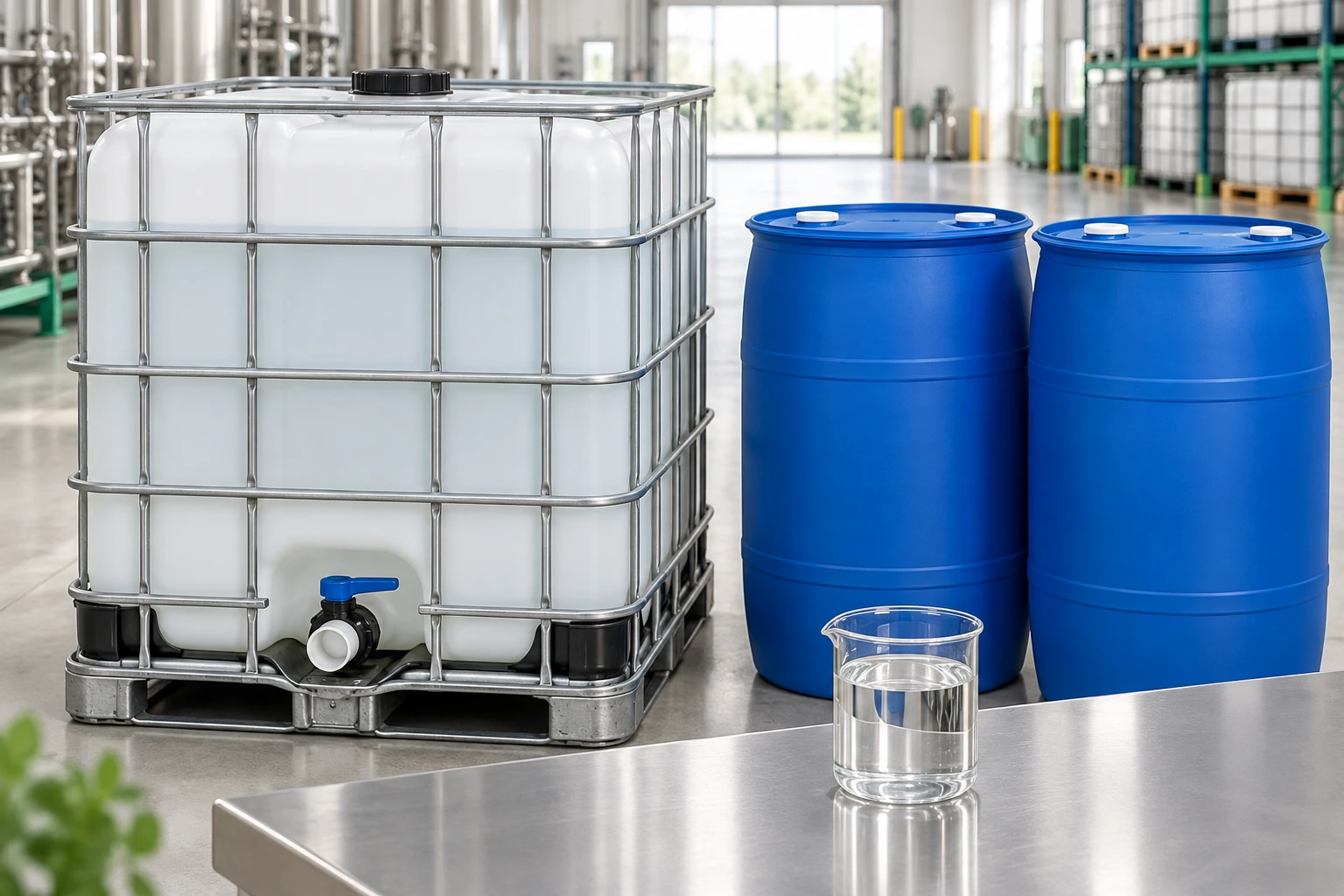
Choose drums or IBCs for sorbitol 70% by comparing delivered cost per usable kilogram and checking how the factory will receive, transfer and consume the liquid. The comparison must use the same grade and specification. A package with a lower quoted price can become more expensive if it requires extra equipment, creates larger transfer losses, or remains open longer than the approved handling procedure allows.
The decision belongs to procurement, warehouse, production and QA together. Procurement can compare offers; production needs to confirm transfer capability; QA needs to approve packaging and handling requirements. This guide provides a common basis for that discussion.
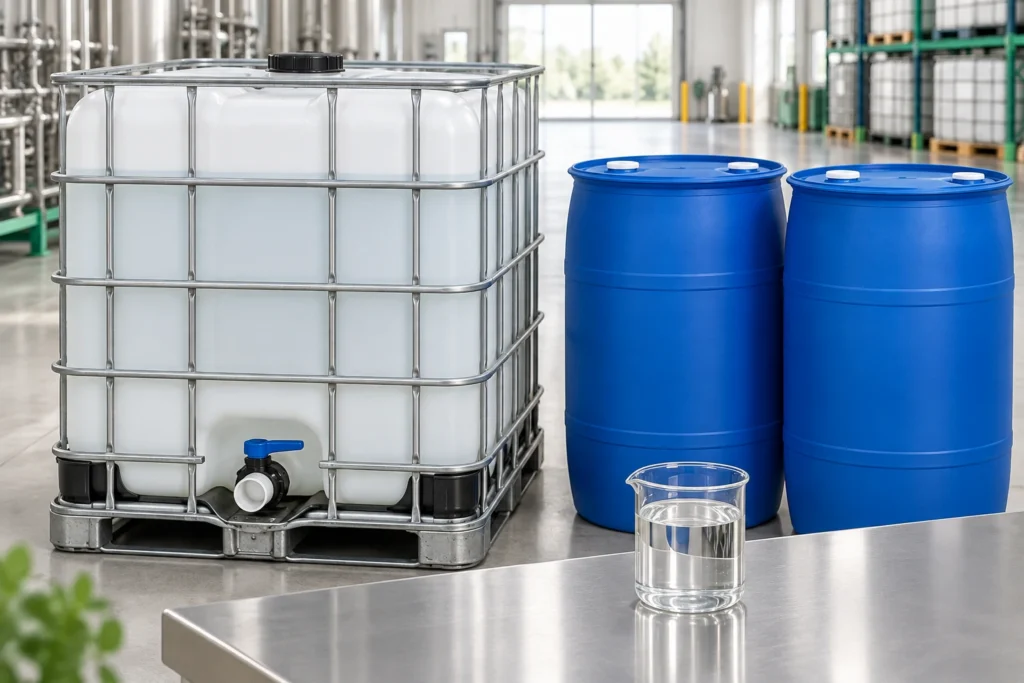
Confirm the product before comparing the package
Start with the required grade, manufacturer, product code, concentration/solids specification and intended application. Match the candidate’s technical specification and batch-document requirements to the approved ingredient. Do not substitute a different grade simply because it is available in a preferred container.
The term “70%” needs to be read with its specification and test basis. Do not automatically treat a reported solids percentage as an identical sorbitol assay, or compare a wet solution price with a powder price. For example, Roquette’s NEOSORB 70/02 B page reports composition on a dry basis; that product-specific figure is not an assay specification for every 70% solution. For this packaging decision, keep both offers on the same product basis; assess grade substitution separately.
Palmart’s sorbitol product page lists drum and IBC formats. Ask which exact formats, fill weights and grades can be quoted for your destination. As a manufacturer example, Gulshan’s sorbitol page lists export drums of 300 kg and 270 kg, along with IBC options. This demonstrates why buyers should request a confirmed fill weight rather than assume one universal package size.
Separate container capacity, net fill and shipment weight
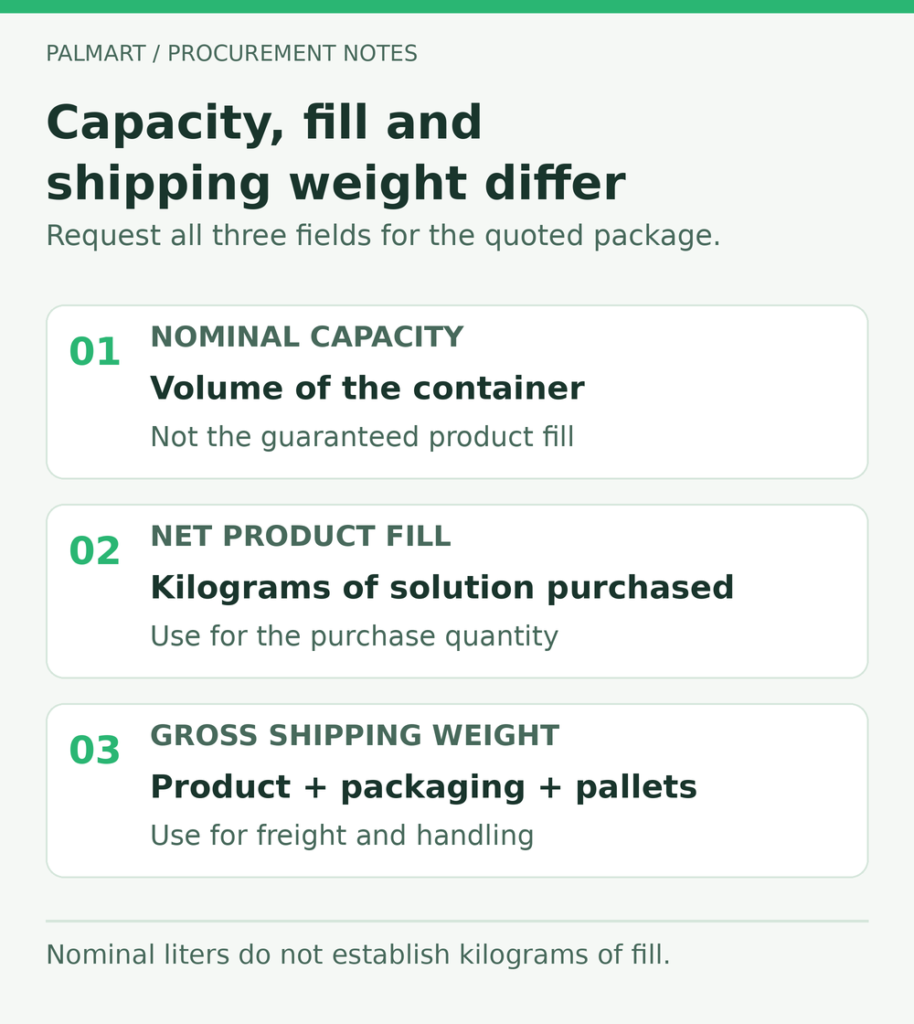
An IBC’s nominal volume is not its guaranteed sorbitol net weight. Request the actual fill quantity, gross weight, tare, dimensions and pallet arrangement for the offered package. These are different fields, each serving a different purchasing or logistics calculation.
| Field | Use in the buying decision | Common mistake to avoid |
|---|---|---|
| Net product weight, kg | Determines how much liquid solution is purchased | Using nominal liters as kilograms |
| Gross shipping weight, kg | Supports freight and handling planning | Excluding packaging and pallets |
| Package count and dimensions | Supports storage and load planning | Assuming the same count fits every route |
| Rated handling/stacking limits | Supports equipment and warehouse suitability | Inferring limits from the cage or drum’s appearance |
| Usable transferred quantity, kg | Supports actual cost per kilogram reaching production | Ignoring residual liquid and measured losses |
Manufacturer load examples are not a booking guarantee. Confirm container payload, gross cargo weight, package dimensions, securing arrangements and inland restrictions with the logistics provider for the actual route.
Compare handling at your factory
| Operational question | Drum offer | IBC offer |
|---|---|---|
| How is liquid transferred? | Confirm the approved drum pump, connection and movement method. | Confirm valve connection, pump where needed and controlled transfer method. |
| How many containers will be opened? | Calculate from actual fill weight and consumption per shift. | Calculate from the offered fill weight and the approved open-use procedure. |
| Can equipment handle the gross load? | Check lifting aids and the safe movement procedure. | Check forklift capacity, access, floor space and receiving constraints. |
| What stays behind? | Measure residual product and transfer losses under normal use. | Measure residual product, including the outlet and transfer system. |
| What happens to empty packaging? | Confirm disposal, collection or return terms and any cost. | Confirm ownership, deposit, collection and return condition if applicable. |
An IBC can reduce the number of package openings when its confirmed fill weight is larger than a drum’s. That does not establish lower labor cost or better hygiene at every plant. Both depend on the actual transfer system and operating procedure. A factory dosing small quantities into different lines may evaluate the formats differently from one consuming a full IBC through a dedicated closed connection.
Packaging hygiene is part of the specification
Request evidence of suitability for the intended food-contact use, package material and condition, closure and seal details, and traceability. Ask whether the quoted package is new or reconditioned, and what evidence supports its suitability. Do not infer food-contact compliance from the color of a drum or the word “IBC.”
SCHÜTZ’s food-packaging guidance describes packaging manufacture and hygiene controls as part of its FOODCERT approach. That is a useful example of the kind of packaging evidence a buyer can investigate; it does not establish the certification or compliance of another supplier’s package.
Also agree the process after opening: connection hygiene, transfer equipment, closure between uses, storage conditions and permitted use period under the manufacturer’s instructions and the factory’s approved procedure. Do not carry the unopened shelf-life claim over to an opened container without supporting guidance.
A worked delivered-cost comparison
Use this calculation:
Cost per usable kg = comparable delivered and handling cost ÷ usable quantity transferred to production.
Include product, packaging, buyer-paid freight, destination charges, handling and empty-package costs. Separate refundable deposits and recoverable taxes from permanent expense, while tracking their cash effect. If extra equipment is required, allocate its cost using a stated expected usage rather than hiding it in a price comparison.
The following figures are hypothetical, not supplier fill-weight guarantees, measured factory results or current Palmart prices. Both offers cover 6,000 kg of the same approved sorbitol solution delivered to the same factory.
| Input / result | Drums | IBCs |
|---|---|---|
| Illustrative packing | 20 × 300 kg | 5 × 1,200 kg |
| Product and delivery | €5,520 | €5,580 |
| Handling and empty-package cost | €150 | €60 |
| Total comparable cost | €5,670 | €5,640 |
| Assumed unusable residual/transfer loss | 1.5% = 90 kg | 0.5% = 30 kg |
| Usable transferred quantity | 5,910 kg | 5,970 kg |
| Cost per usable kg | €0.9594/kg | €0.9447/kg |
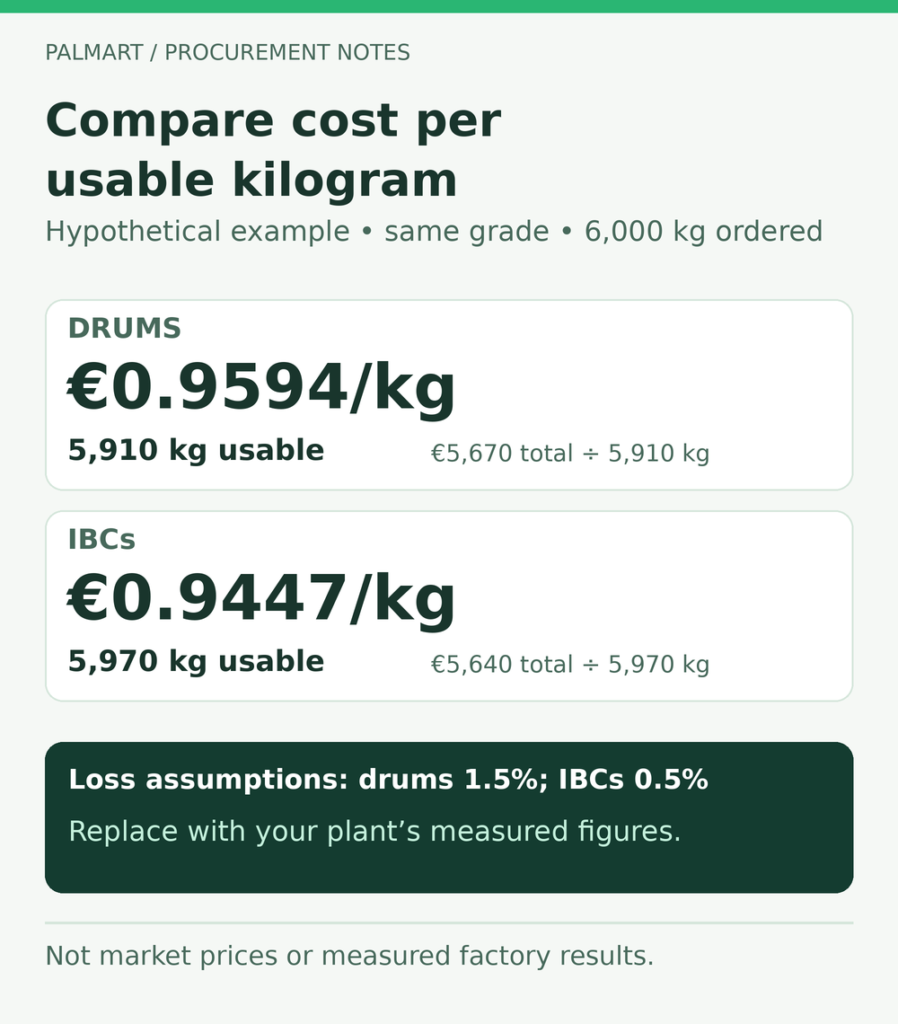
In this example, the IBC offer has a higher product-and-delivery amount but a lower cost per usable kilogram after the stated handling and loss assumptions. Replace those assumptions with your plant’s measured figures. If the IBC requires new transfer equipment or creates more loss at your site, the result can reverse.
Before placing the order, complete one comparison record
- QA confirms that both offers meet the same product and packaging requirements.
- Warehouse confirms gross weights, dimensions and handling limits.
- Production confirms the transfer connection, pump and expected consumption pattern.
- Purchasing checks price basis, delivery point, payment, MOQ and validity.
- The team records measured or provisional transfer losses and labels assumptions clearly.
- Receipt, document review and production release are assigned to named roles.
For the broader approval sequence, use Palmart’s supplier qualification checklist alongside this package-specific comparison.
Frequently asked questions
Are IBCs always cheaper than drums for sorbitol 70%?
No. Compare the actual offer and the factory’s usable yield, equipment, handling, consumption and empty-packaging arrangements.
How many kilograms does an IBC hold?
Ask for the supplier’s confirmed net fill for the exact package. Nominal container volume alone does not provide the answer.
Should I compare cost per kilogram of solution or dry solids?
For two equivalent solution grades, cost per usable kilogram of solution is a practical packaging comparison. If concentrations differ, first compare specifications and use an agreed solids or assay basis where relevant. Dry solids and sorbitol assay must not be assumed identical.
Request a sorbitol packaging quotation from Palmart
Send the required specification, application, quantity, drum/IBC preference, destination, delivery basis, required date, and unloading/transfer arrangements through the Palmart contact form. Request confirmed net fill, gross weight and packaging details so that the commercial offer can be compared against your plant’s requirements.
Prepare the request with the sorbitol drum-versus-IBC comparison template.
