



Before ordering palm shortening for a hot-weather route, agree the exact grade, its manufacturer-approved handling conditions, the shipment plan, and the arrival acceptance procedure. A melting-point figure or a generic instruction to “keep cool” is not enough to select transport conditions. The decision needs to cover the whole journey, including loading, terminal waiting, inland delivery, and receiving storage.
For procurement teams, the useful question is not simply whether the shortening will arrive solid. It is whether the supplied grade and packaging will reach the factory in a condition that meets the agreed specification and production requirements. Set those requirements before comparing freight offers. 
Start with instructions for the grade you are buying
Palm-based shortenings are formulated for different applications. A statement about one product does not establish the transport tolerance of another. Cargill’s Socfat product page, for example, specifies original packaging, cool and dry storage, and protection from sunlight and strong odors. It does not provide a universal hot-weather transport limit for all palm shortening.
Cargill’s 2019 PalmAgility announcement also identifies temperature fluctuations during transport as a challenge addressed by that particular formulation. The purchasing implication is to request guidance for the actual offered grade, rather than assume every palm shortening behaves alike.
Ask for the current technical data sheet, packaging specification, shelf life, storage instructions, and any transport or temperature-excursion guidance available from the manufacturer. If the guidance is qualitative, send the proposed route and obtain clarification before choosing equipment. Palmart’s shortening product page is the relevant starting point for a supply inquiry; the final grade and conditions still need confirmation.
Map the exposure points, including time spent waiting
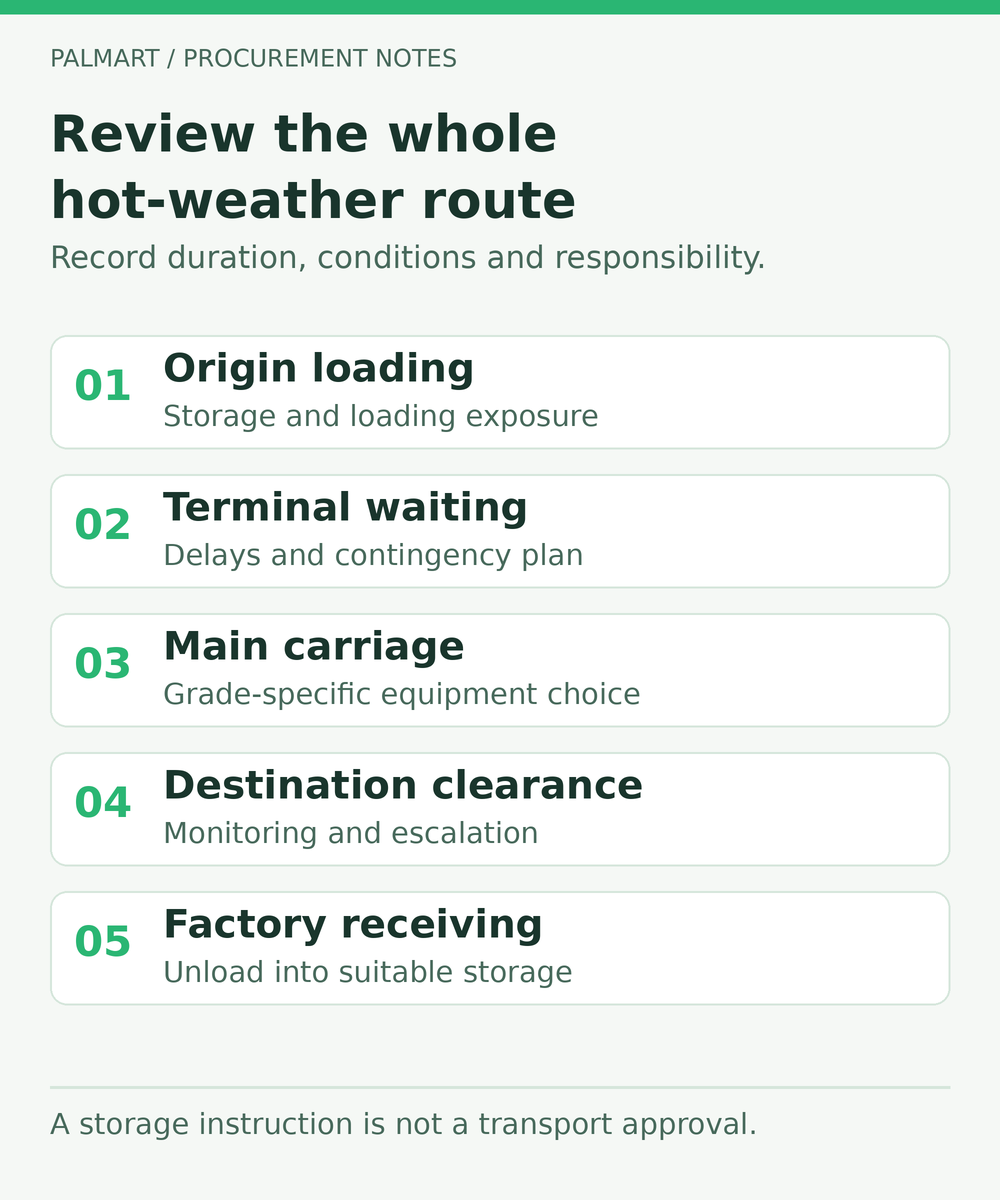
A port-to-port transit estimate covers only part of the order. Prepare a route worksheet with each location, expected duration, exposure concern, and person responsible for arranging the agreed conditions. Include a contingency for delays rather than treating the planned schedule as certain.
| Journey stage | Question to resolve | Evidence to request |
|---|---|---|
| Origin storage and loading | How will cargo be held before and during loading? | Handling instructions, loading plan, packaging photographs |
| Origin terminal | What happens if the container waits longer than planned? | Booking details, contingency contact, agreed equipment plan |
| Main carriage | Is the selected equipment suitable for this grade and route? | Manufacturer guidance and written logistics confirmation |
| Destination clearance | Who monitors delays and arranges the next movement? | Clearance responsibilities and escalation contacts |
| Final delivery and receiving | Can the factory unload promptly into suitable storage? | Appointment, unloading arrangements, receiving procedure |
Dry container, insulation, or temperature-controlled transport?
Do not choose a transport mode from the season alone. Compare each proposed option with the product instructions, route exposure and packaging. A dry-container option should be supported by a review of those conditions. Insulation should be described precisely, with its limitations; do not accept an unspecified liner as a guarantee of product protection. If temperature-controlled transport is proposed, agree the operating instructions, set point where applicable, monitoring, power arrangements and response to interruptions.
These are questions for the manufacturer and logistics provider to settle together. A refrigerated booking is not a substitute for suitable loading or receiving storage, and a warehouse storage temperature is not automatically an approved transport temperature. If the available documentation does not establish suitability, keep equipment selection open until the supplier clarifies it.
Write the packaging requirement into the order
Specify the actual net weight per carton, liner material, closure, pallet arrangement, stacking limits and securing method. Request confirmation that the packaging is suitable for the agreed handling conditions. Cargill lists several PE-lined carton sizes for Socfat; those published formats are examples for that product, not confirmation of Palmart’s available pack sizes.
For a first shipment, request photographs that show the product identification, liner/closure arrangement where available, intact cartons, pallet protection and loaded condition. Photographs can support the shipment record but cannot prove that every carton or the entire journey met requirements. Keep batch identification linked to the packing list and the supplied COA.
Agree responsibility and evidence before dispatch
The sales agreement should identify who books transport, communicates the product requirements, places monitoring devices if used, retrieves records, and responds to delays or damaged packaging. Use a named place or port with the agreed delivery term. ICC’s Incoterms® guidance explains the allocation of delivery tasks, costs and risks; product acceptance criteria and excursion procedures still need their own written agreement.
If monitoring is necessary, specify the device, placement, recording interval, retrieval method and reviewer. A reading from one logger documents that location; it should not be treated as a temperature measurement of every carton. Also record what happens when data are missing. A procedure agreed after an incident leaves both parties trying to reconstruct expectations.
A practical receiving and release checklist
Prepare the acceptance plan with QA before the truck arrives. Separate physical receipt from release for production. A useful record includes the following fields; each requires an observation or decision, rather than a pre-ticked approval.
| Check | Record | Action if unresolved |
|---|---|---|
| Identity and quantity | Grade, batch, carton count, net weight and document match | Reconcile the discrepancy before release |
| Packaging integrity | Condition of cartons, liners, pallets and seals where used | Segregate affected cargo and photograph observations |
| Shipment conditions | Available journey/temperature records against the agreed requirements | Request missing records or manufacturer review |
| Product condition | Observations and tests specified in the acceptance plan | Refer deviations to QA; do not infer acceptance from appearance alone |
| Production suitability | Trial result where required, compared with the approved reference | Hold the affected lot until an authorized disposition |
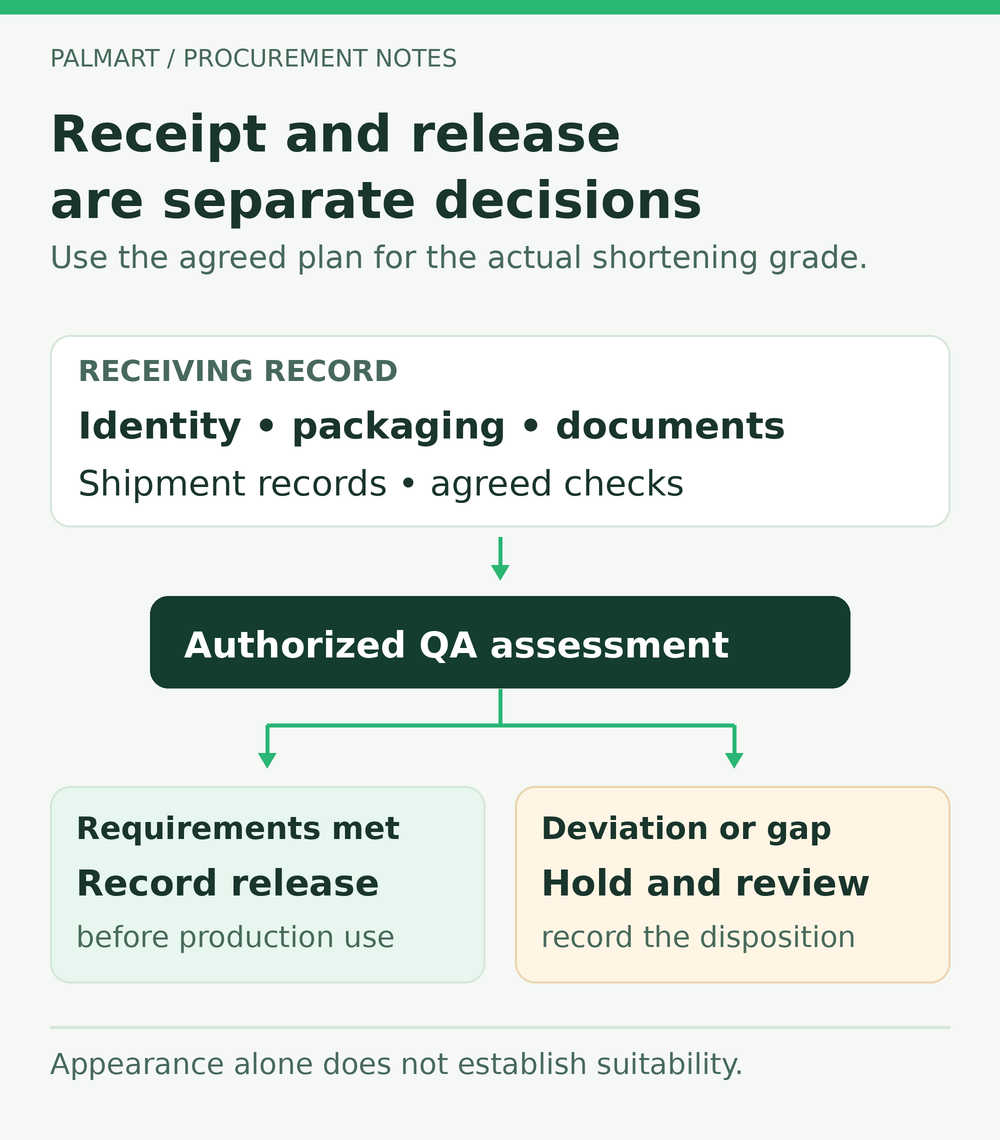
If shortening arrives unusually soft, with visible oil separation, damaged liners or another deviation, record the facts and preserve traceability. The authorized QA team should seek the manufacturer’s assessment and decide the disposition. Do not assume cooling or re-solidification alone restores suitability. Any conditioning or rework should follow a validated, approved procedure for the grade and intended use.
Compare the shipment options on the same basis
Request a quotation that separates product, packaging, transport equipment, monitoring, insurance and destination costs. Compare the same grade, net quantity, delivery point and acceptance conditions. A cheaper freight offer with unspecified handling requirements is an incomplete offer, so first close the information gaps.
For illustration, if a confirmed alternative transport plan costs an extra €600 for a 20,000 kg shipment, the freight difference is €0.03/kg. This is arithmetic, not a market quote or proof that the option is worthwhile. The next question is whether the plan meets the grade-specific requirements and what other costs it includes.
For background on application selection, read Palmart’s guide to shortening performance in bakery manufacturing. This shipment checklist should be completed after the appropriate ingredient has been selected.
Frequently asked questions
What is the maximum shipping temperature for palm shortening?
There is no single limit established here for all grades. Obtain the actual manufacturer’s instructions and review temperature, duration, packaging and route together.
Does every summer shipment need a refrigerated container?
The equipment choice depends on the grade and agreed route conditions. Obtain a documented suitability assessment instead of applying one rule to every order.
Can a softened shipment be accepted once it becomes solid again?
Appearance alone does not establish conformity or production performance. Follow the acceptance plan and obtain an authorized QA disposition supported by the necessary evidence.
Request a route-specific shortening quotation
Send Palmart the application, required grade or current specification, net quantity, packaging preference, origin/destination where known, required arrival date, and available storage and unloading arrangements. Use the Palmart contact form to request available product documents and discuss the delivery conditions that need confirmation.
Use the hot-weather shipment planning template to prepare a complete request.
