


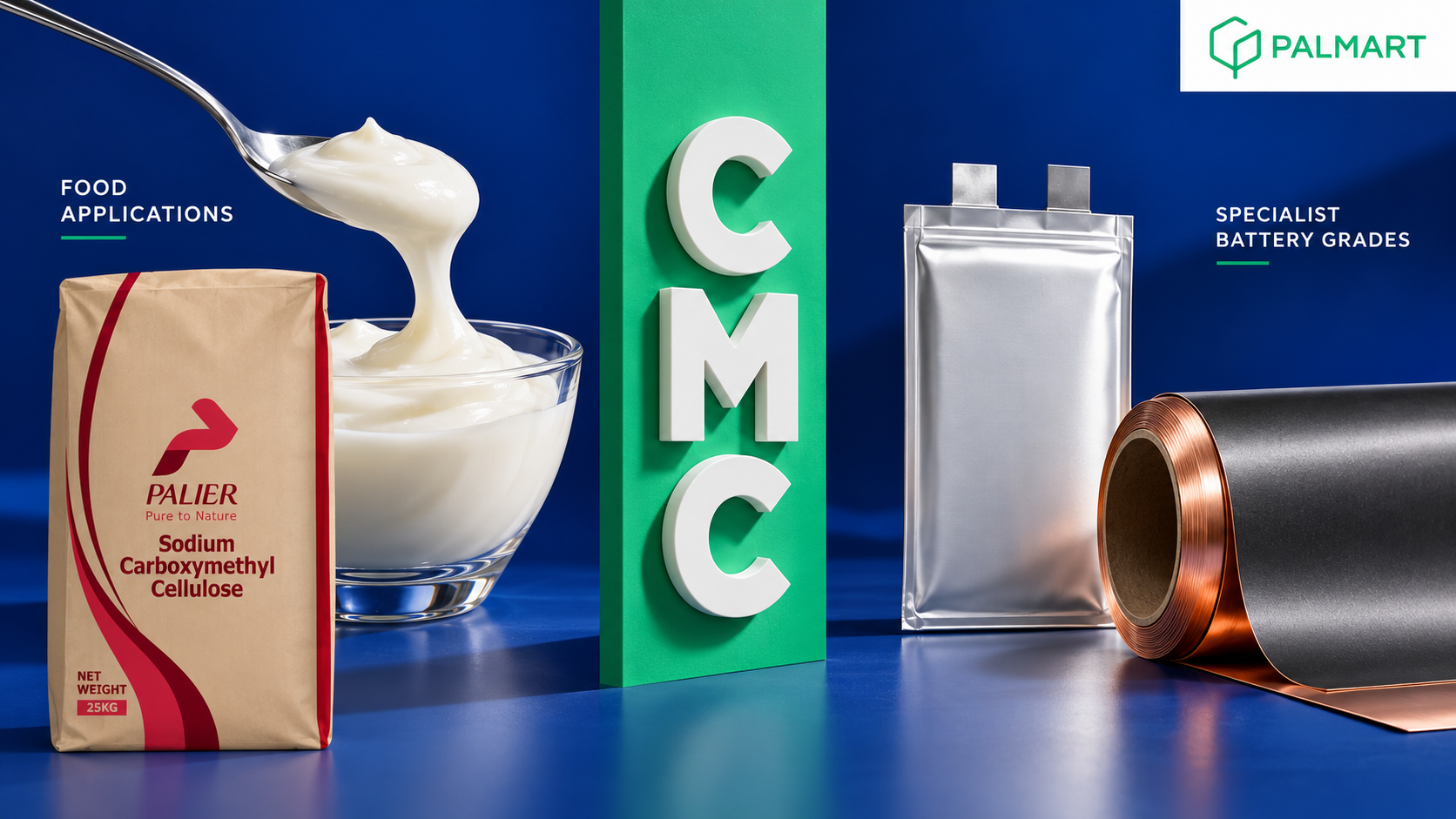
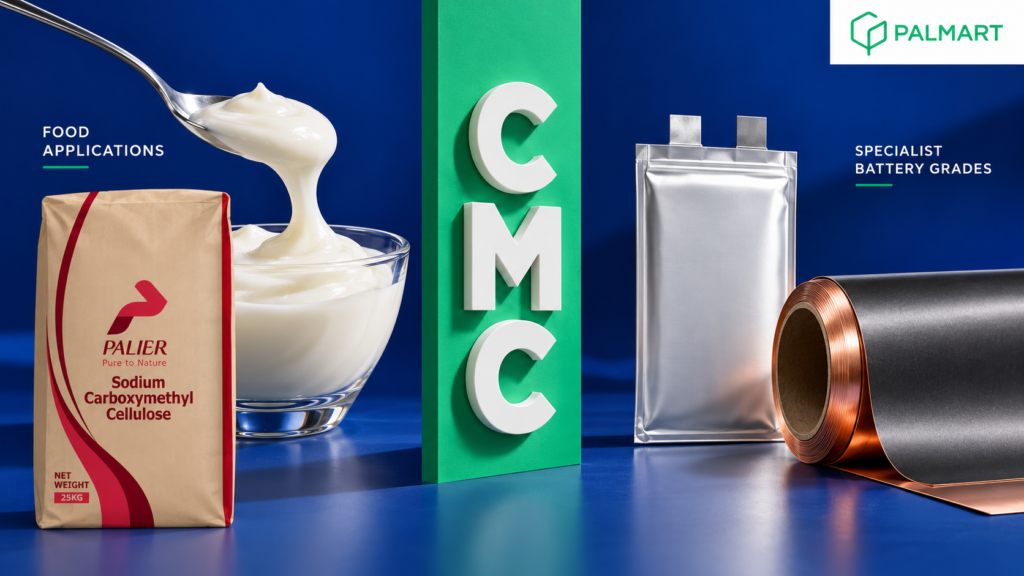
Carboxymethyl cellulose (CMC), also called cellulose gum, has roles in both food and lithium-ion battery manufacturing. In food, suitable grades help manage texture and stability. In batteries, specialist grades help with electrode-slurry processing and binding. The connection is real; the grades and their intended jobs differ.
That gives this familiar ingredient an unexpected second career. The powder associated with a creamy dessert also belongs to a material family used to help manufacture a battery electrode. The interesting part is the work between the ingredients and the finished product.
Why does CMC turn up in such different industries?
CMC is a water-soluble cellulose derivative. Its usefulness comes from how its polymer chains interact with water and other components. Different grades can perform as flow modifiers, binders, dispersants and film-forming materials. Nouryon’s CMC portfolio separates food, industrial and battery applications, illustrating how the material family is adapted to different assignments.
Think of that family as a versatile profession. Sharing a profession does not make every specialist qualified for every assignment. The relevant question is what behaviour the finished system needs, followed by which documented grade can provide it.
The battery job: helping an electrode coating come together
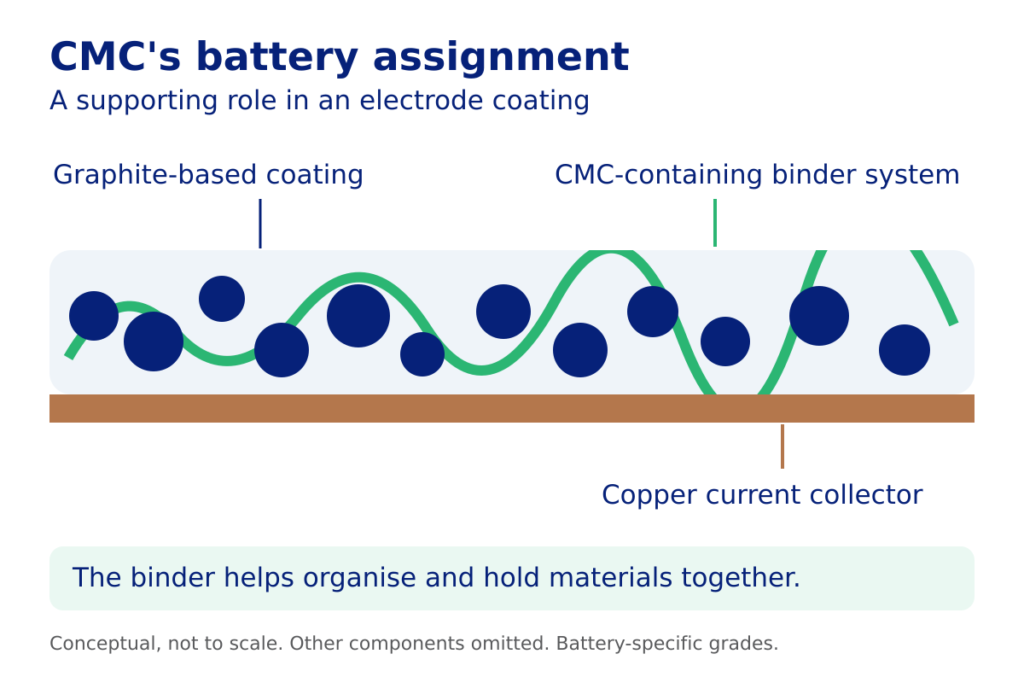
In a graphite-based lithium-ion anode, solid materials must be prepared into a slurry and applied as a coating. The binder system helps the coating hold together and adhere to its support. Flow and dispersion also matter during manufacturing.
Nouryon’s battery-specific CMC documentation describes roles in graphite dispersion, slurry stability, coating and adhesion, commonly in combination with styrene-butadiene rubber (SBR). This is a supporting material role in electrode manufacture. The CMC itself is not the electrode’s energy-storage active material.
There is also a useful research example. A 2023 study listed by Oak Ridge National Laboratory investigated kneading a CMC binder during anode preparation. The researchers reported increased adsorption of sodium CMC onto graphite and improved slurry dispersion. Their further lithium-CMC findings belong to the specific process and electrode system studied; they are not results for Palier CMC.
This second career has an industrial footprint. In May 2025, Nippon Paper announced the completion of a CMC factory in Hungary for its lithium-ion battery supply business. The announcement concerned its SUNROSE MAC product and European electric-vehicle battery supply chain, providing a concrete example beyond a laboratory experiment.
The food job: shaping how a product behaves
A food manufacturer has a different assignment. A dessert needs an appropriate spoonable texture. A beverage may need its components to remain well distributed. A filling must behave suitably during processing and eating.
In these settings, food-grade CMC can contribute to viscosity, water management and stability. IFF’s food-application documentation describes tailored CMC systems for food and beverages, including dairy texture, suspensions and other formulation needs. Their examples establish possible category functions, rather than a performance guarantee for another supplier’s grade.
The connection with batteries is therefore more interesting than a shared name on two lists. Both industries need to organise a mixture into something that behaves reliably. The materials, processes and definition of success change with the application.
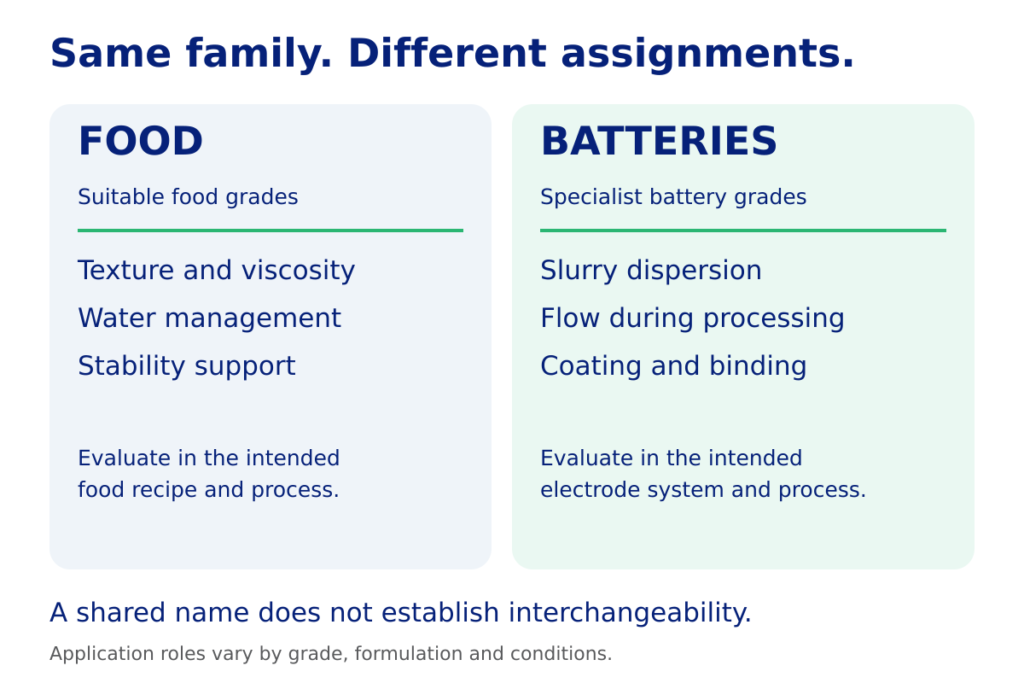
Same polymer family, different assignments
| Question | Food application | Specialist battery application |
|---|---|---|
| What is being made? | A food or beverage with a defined eating experience | An electrode coating within a battery system |
| What might CMC contribute? | Texture, viscosity, water management or suspension support | Slurry dispersion, flow control and binder-system performance |
| What demonstrates a suitable choice? | Relevant food-use documentation and evaluation in the intended recipe and process | Battery-specific specifications and evaluation in the intended electrode process |
| Does the common name establish interchangeability? | No. Application-specific documentation and performance evaluation remain necessary. | |
What can a food buyer take from the battery connection?
Start a CMC discussion with a description of the finished product. For example: “We are developing a spoonable dessert and need a particular texture after our existing process.” That gives the technical discussion a meaningful target.
A useful inquiry identifies the food application, the desired behaviour, the current processing conditions and the destination market. If an existing grade or specification is already approved, include it. This makes it easier to establish which documents and comparisons are relevant before a formulation trial.
The same principle explains CMC’s surprising second career: a material earns its place by performing a defined job. A recognisable ingredient name starts the conversation; the application determines what needs to be checked.
Explore Palier CMC for food applications
Palmart’s CMC product page outlines food-related functions and applications, including beverages, bakery, sauces, dairy and confectionery. For an inquiry about Palier CMC, tell us what you manufacture, the behaviour you want to achieve, your destination and any existing grade requirements. Ask which current product documents are available for that intended use.
Contact Palmart about your CMC application or explore the ingredient portfolio.
Quick questions
Is cellulose gum the same ingredient name as CMC?
In food contexts, cellulose gum commonly refers to sodium carboxymethyl cellulose, often abbreviated CMC. The grade designation is still needed to identify a particular offered product.
Does using CMC in batteries mean food-grade CMC is interchangeable with battery CMC?
No. A shared chemical family does not establish suitability for a different use. Food and battery applications require their own documentation, specifications and performance assessment.
Is Palier CMC being presented here as a battery material?
No. This article explains the wider CMC family’s battery connection. The Palier product shown in this campaign is presented for food applications.
