
Propylene glycol can help retain aroma compounds in some formulations. A peppermint-powder experiment offers a useful example. For manufacturers, the next step is to test whether that benefit translates into the flavor, texture and storage performance their own product needs.
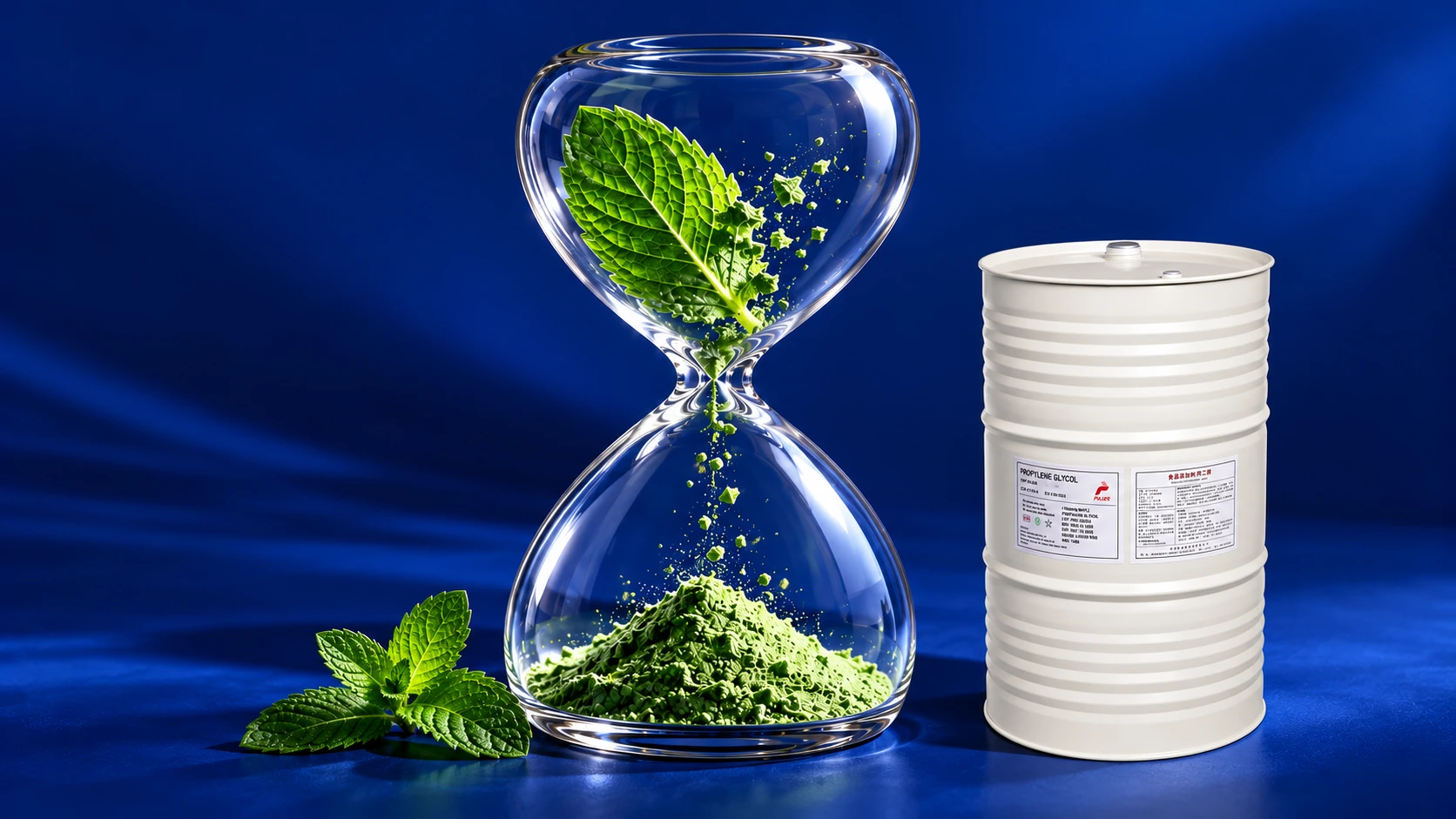
A fresh sample can make an excellent first impression. Open the same product later, and the question becomes more demanding: does it still deliver the aroma that made the formulation worth approving?
That is the commercial reason to investigate flavor retention. An ingredient decision should survive the journey from development sample to the product a customer actually experiences.
What does propylene glycol do in flavor formulations?
Propylene glycol, often shortened to PG, is a liquid used as a solvent and carrier in flavor formulations. It is also hygroscopic, meaning it attracts moisture. These functions make it relevant to both the delivery of flavor ingredients and the behavior of water within a formulation. Manufacturer technical information describes its carrier, solvent and humectant functions. See Dow’s technical overview of PG USP/EP.
For a development team, separate the questions those functions raise:
- In the flavor preparation: does the carrier provide the required compatibility and handling?
- In the finished product: does the formulation deliver the intended aroma immediately and after storage?
- During manufacture: can the chosen addition method be reproduced consistently?
A clear, uniform flavor preparation is a useful starting point. Approval should also depend on how it performs after incorporation into the actual food.
What did the peppermint-powder study find?
A 2023 peppermint-powder study reported these GC–MS results after 90 days. Read the published abstract.
| Experimental sample | Reported retention |
|---|---|
| Peppermint powder without PG | 40.94% |
| Peppermint powder with 2% PG (PG2) | Approximately 72.56% |
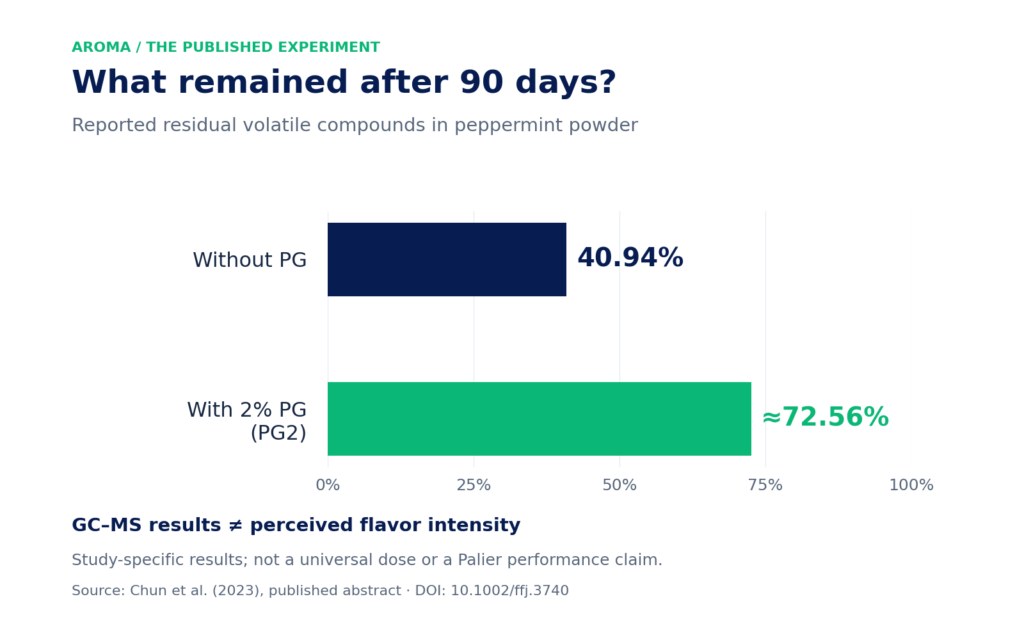
Researchers linked greater retention with more strongly bound water; a higher PG treatment showed poorer moisture-retention behavior.
Keep the result in scope: these experimental results establish neither Palier performance nor a universal dose. The accessible abstract provides insufficient detail to reproduce the full method.
Retained aroma compounds and perceived flavor are different measures
An analytical result describes what a method detects. A sensory evaluation asks what people perceive when they smell or consume a product. A useful development program makes room for both.
This distinction appears in separate research on shortcake biscuits. Yang and colleagues compared PG and triacetin as flavor solvents during accelerated storage. Biscuits made with triacetin retained vanillin better, while the study reported no significant storage effect on the sensory ratings it assessed. See the biscuit flavor-solvent study.
For manufacturers, this is a reason to define the desired outcome precisely. “More retained material,” “a stronger mint note” and “a preferred eating experience” are three different objectives. Choose measurements that can answer the one your project actually depends on.
Why the food matrix matters
Peppermint powder, a liquid flavor concentrate and a baked biscuit present different environments for aroma ingredients. Evidence from one system can justify a trial in another, but the new trial still needs to establish its own result.
Research on peppermint essential oil encapsulated in modified starches offers another example. The researchers found that aroma release differed between encapsulated products and that leakage during storage increased with water activity. Read the peppermint encapsulation research.
For a practical comparison, document the complete formulation and its condition at the time of evaluation. Record the ingredient lots, carrier contribution, packaging, storage environment and relevant moisture measurements. That record makes the result interpretable when a later batch behaves differently.
PG can therefore be a candidate ingredient in an aroma-retention project. Its suitability should be decided within the complete product and process.
How to evaluate PG for flavor retention in your own product
The following is a proposed development checklist, rather than a prescribed laboratory standard. Adapt it with your technical and quality teams to the product, intended market and available methods.
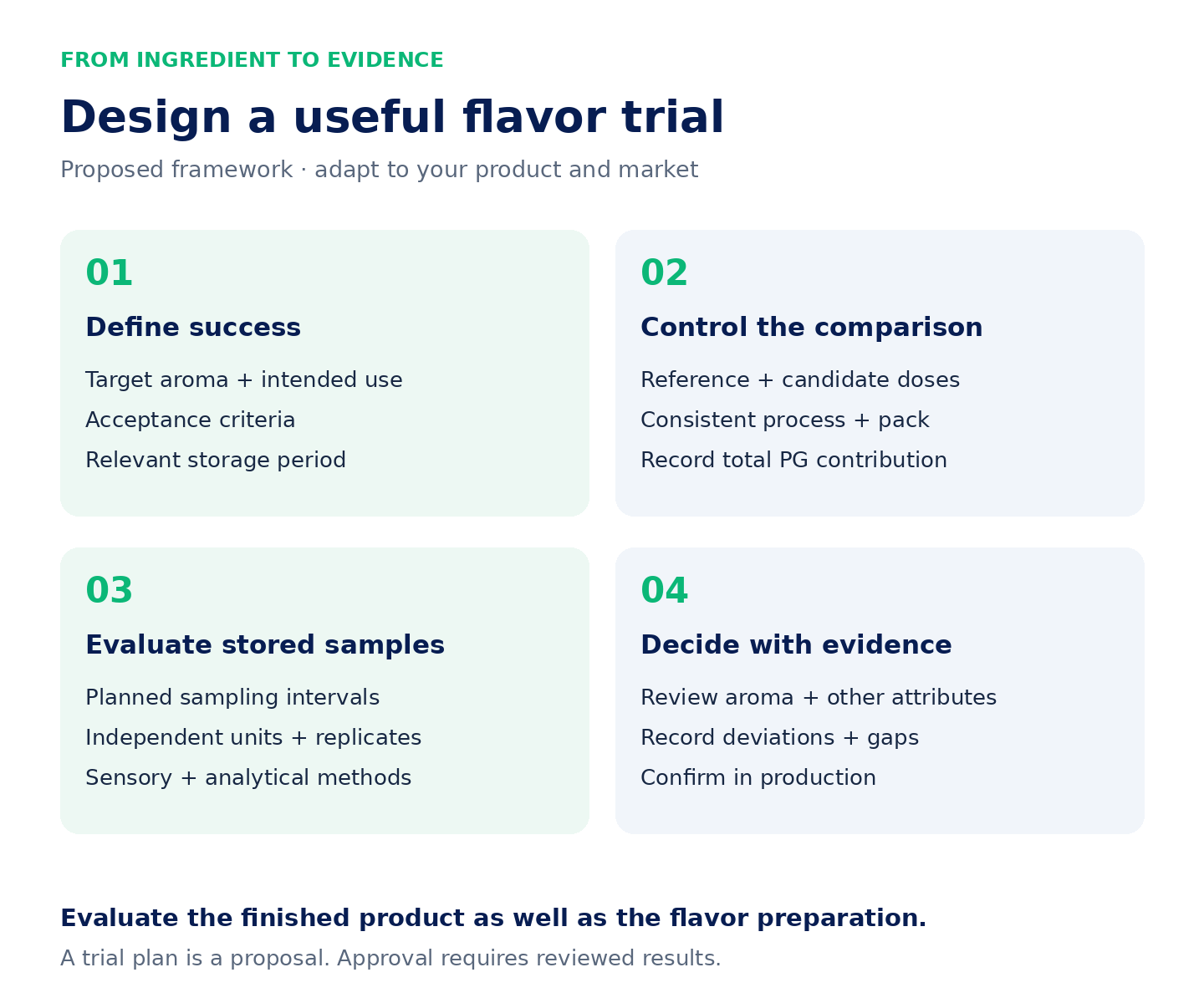
1. Define success before preparing samples
Write down the characteristic you want to preserve. For a mint application, this could be the recognizable mint aroma at the intended point of use. Agree on an assessment method, an acceptable outcome and the storage period that matters commercially.
Decide whether you are evaluating the ingredient preparation, the finished product or both. A positive result in a stored flavor preparation does not complete the evaluation of a food made with it.
2. Build a controlled comparison
Use your current formulation as the reference. Select candidate PG levels with the technical team after checking the intended use, ingredient grade and destination requirements. Document how the formulation is balanced when PG changes, and account for PG already introduced through other ingredients.
Keep production and packaging conditions consistent across samples wherever practical. If several variables must change, record them explicitly so that the comparison does not become a claim about PG alone.
3. Compare fresh and stored samples
Evaluate samples at the start and at planned intervals through the relevant storage period. Use independently sealed units for each interval where practical, so repeated opening does not become an uncontrolled part of the experiment. Include independent batch replication appropriate to the decision and resources available.
Use coded samples and a consistent sensory procedure. Where analytical testing is available, agree with the laboratory on suitable marker compounds, the measurement method and how results will be normalized. Review the analytical and sensory evidence together.
| Record | What to specify | Question it helps answer |
|---|---|---|
| Product and objective | Application, target aroma and acceptance criteria | What outcome justifies approval? |
| Formulation | Reference, candidate PG levels, dose basis and total PG contribution | What actually changed? |
| Process | Addition sequence, mixing, temperatures and hold times | Was each sample produced comparably? |
| Packaging | Pack material, closure, fill and headspace | Was the comparison made in the intended pack? |
| Storage and sampling | Conditions, intervals, independent units and batch replicates | Does the trial represent the commercial question? |
| Evaluation | Coded sensory procedure, analytical method and relevant moisture checks | Do the measurements support the intended benefit? |
| Other product attributes | Relevant texture, flow, appearance and handling observations | Was any aroma benefit accompanied by a trade-off? |
| Decision | Results, deviations, reviewer and remaining work | What is supported, and what still needs validation? |
For an editable record, use the accompanying flavor-retention trial worksheet. It provides planning and results fields without implying that a trial or approval has already occurred.
4. Confirm the result under production conditions
Choose a candidate using the agreed criteria, then confirm its behavior in a representative production trial. Keep the storage assessment connected to that production sample. Palmart’s guide to food formulation scale-up provides a broader framework for reviewing process changes between development and manufacturing.
What to discuss when sourcing propylene glycol
Give the supplier enough context to identify the material and documentation relevant to your project. Specify the food application, required grade, destination, pack format and anticipated volume. Ask which technical documents are available for the offered grade and how the supplied lot will be identified.
Palmart lists propylene glycol among its ingredient offerings. Explore the propylene glycol product page, then contact Palmart with your application and sourcing requirements to discuss available information for a formulation trial.
Frequently asked questions
Is a flavor carrier the same as an aroma-retention solution?
A carrier’s performance in the flavor preparation is one part of the assessment. Evaluate the finished product after processing and storage before making a retention claim for that application.
Should a stronger fresh aroma determine the winning formulation?
Use the project’s agreed criteria across the intended storage period. A strong first impression can be useful, but the purchasing and approval decision should reflect the product experience you need to maintain.
What should a manufacturer request before a trial?
Request the available specification and handling information for the proposed grade, identify the lot used, and agree internally on the application, dose basis, destination checks and evaluation plan.
